


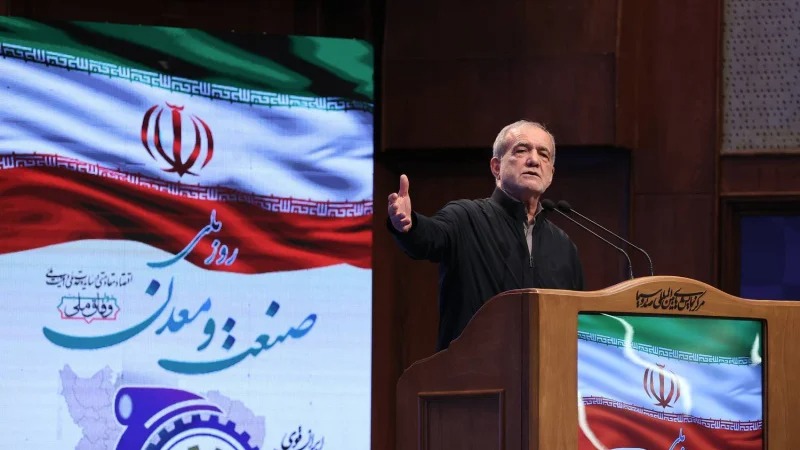
Iranian President Masoud Pezeshkian has defended an agreement with the United States, calling it the best option for protecting Iran’s national interests and economy as tensions between the two countries remain high.
In a speech published by Iran’s official news agency on Sunday, Pezeshkian rejected claims that the agreement would mean surrender. He said the Supreme National Security Council had reviewed the deal and viewed it as the best possible choice based on national interest, wisdom and dignity.
Pezeshkian said the agreement does not force Iran to give up its rights. He also said his government would follow policies set by Supreme Leader Ayatollah Ali Khamenei.
The Iranian president stressed that Tehran does not plan to retreat in the face of its rivals. At the same time, he said Iran needs better economic conditions and access to investment.
Pezeshkian said investors are highly sensitive to risk. He argued that Iran cannot attract enough new capital while its economy remains under heavy pressure and uncertainty.
That pressure has increased after months of conflict involving Iran, the United States and Israel. Sanctions and limits on trade have hurt Iran’s ability to sell oil and earn foreign currency. The situation has added to the need for economic relief.
Iranian media have said the agreement contains no major concessions from Tehran. However, tensions remain high as Washington continues to threaten further economic action.
US President Donald Trump has warned that his administration will put strong pressure on Iran’s economy. Treasury Secretary Scott Bessent has also warned of new measures against Tehran.
Iran has responded with its own threats. Mohsen Rezaee, a member of Iran’s Supreme National Security Council, said Tehran would target the interests of countries that help the United States in its economic campaign against Iran.
The dispute is part of a much longer conflict. The United States, European Union and United Nations have imposed different sanctions on Iran over many years. The measures have focused on issues including Iran’s nuclear programme, human rights record and support for armed groups.
In Washington, US House Speaker Mike Johnson has said he wants the conflict to end before the November congressional elections. Speaking on Sunday, Johnson said reaching an agreement within the next 73 days would be helpful.
Johnson also said he believes Republicans can win the elections regardless of how the Iran conflict develops. He credited Trump with stopping Iran from obtaining a nuclear weapon.
The US speaker said the situation could soon move into a new phase. He noted that oil was still moving through the Strait of Hormuz, a major route for global energy supplies.
Johnson also expressed doubts about Iran’s negotiating position. However, he said allied countries could help move talks forward in stages.
The diplomatic effort is also receiving attention from Pakistan. Iranian Foreign Ministry spokesman Esmaeil Baghaei said Pakistani Army Chief Asim Munir is expected to visit Tehran on Monday.
Baghaei said the visit is part of Pakistan’s wider efforts to support peace and security in the region. Pakistan has maintained relations with both Iran and the United States, giving it a possible role in efforts to reduce tensions.
The planned visit comes as both sides face pressure to find a way forward. For Iran, economic stability is a major concern. For Washington, preventing Iran from developing a nuclear weapon remains a key issue.
The Iran US economic pact could therefore become an important part of wider talks. Its future may depend on whether both sides can reduce threats, protect their core interests and create enough trust for further negotiations.
For now, Pezeshkian is presenting the agreement as a practical step rather than a retreat. His message is clear: Iran wants to protect its position while finding a way to ease the economic pressure facing the country.
