


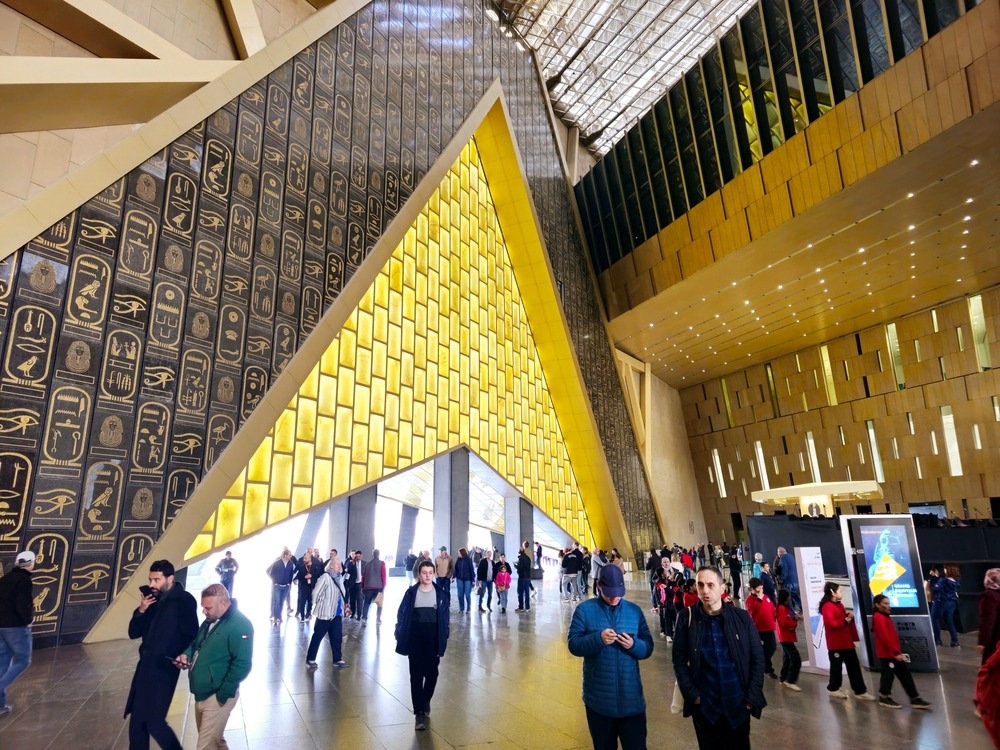
The Grand Egyptian Museum has reached full operational capacity this month, transforming the Giza Plateau into a considerably more extensive cultural destination just as Egypt enters its September tourism season. Nearly a year after its official opening in November last year, the museum has moved past its early operational hiccups to become one of the country’s central draws for visitors exploring ancient Egyptian heritage alongside the neighboring pyramids.
Housing more than one hundred thousand artefacts, including the complete collection of treasures from the tomb of Tutankhamun and the separate Khufu’s Boats Museum, the Grand Egyptian Museum has firmly established itself as the world’s largest archaeological museum complex dedicated to a single civilization. Spanning fifty hectares, the site dwarfs comparable institutions internationally, measuring twice the size of both the Louvre in Paris and New York’s Metropolitan Museum of Art, and roughly two and a half times larger than London’s British Museum.
Museum officials have spent much of this year expanding and refining the site’s digital visitor infrastructure to better handle the sustained high volume of tourist traffic. An upgraded online ticketing platform launched back in April simplified the reservation process and created a more centralized booking channel for visitors planning trips from abroad. That improvement followed earlier operational challenges during the museum’s initial opening weeks, when ticketing confusion led to overcrowding and frustration among visitors unable to secure entry despite having tickets in hand.
Building on that digital ticketing improvement, the museum expanded access to its official booking website through the mobile applications of Egypt’s four major telecommunications operators back in July. This initiative specifically aimed to provide visitors with a direct, reliable booking route while reducing the risk of counterfeit ticket websites that had reportedly caused confusion for some travelers during the site’s earlier months of operation.
For international visitors planning trips to Egypt this September, these digital improvements mean ticket arrangements can now be completed well before arrival in Cairo, rather than depending on uncertain availability discovered only after landing. That shift toward pre-arrival booking certainty represents a meaningful improvement in the overall visitor experience compared to the museum’s more chaotic opening period nearly a year ago.
The museum’s location near Giza places it within convenient reach of Sphinx International Airport, positioned west of Cairo and relatively close to the plateau, adding another layer of accessibility for tourists specifically targeting the Giza cultural corridor during their Egypt itineraries. This geographic convenience has helped position the broader Giza area as an increasingly self contained cultural tourism destination rather than simply a day trip stop from central Cairo.
Egypt’s tourism sector has shown consistent strength throughout this year, with the country welcoming millions of international visitors during the first half of 2026 alone, figures that reflect both the country’s traditional historical attractions and newer additions like the Grand Egyptian Museum expanding the overall visitor experience. Tourism officials view the museum’s full operational maturity as an important complement to existing attractions, giving visitors additional reason to extend their stays around the Giza plateau.
As Egypt moves deeper into its September tourism season, the Grand Egyptian Museum’s transition from a partially finished construction site to a fully realized cultural destination offers tangible evidence of the country’s broader investment in expanding and modernizing its heritage tourism infrastructure, positioning Giza as an increasingly comprehensive destination for visitors traveling specifically to experience ancient Egyptian history and culture.
