


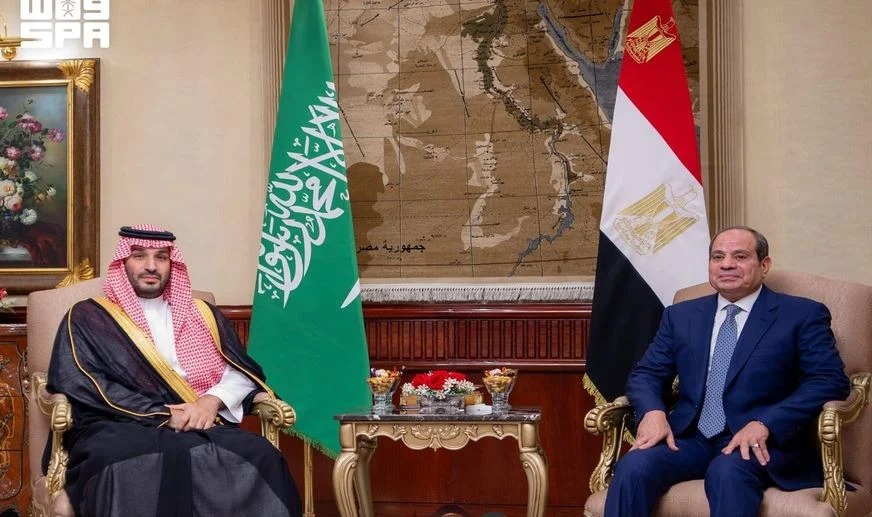
Egyptian President Abdel Fattah al-Sisi and Saudi Crown Prince Mohammed bin Salman stressed the urgent need to ensure freedom and secure navigation through the Bab el-Mandeb Strait and the wider Red Sea during high level talks held this week in Cairo. The meeting brought together Sisi and a senior Saudi delegation that included Foreign Minister Prince Faisal bin Farhan, focusing heavily on maritime security threats that have increasingly disrupted vital shipping routes across the region.
The talks carry particular urgency given recent developments in Yemen, where Houthi rebels have seized control of Mocha port and now effectively command the entire Bab el-Mandeb Strait, a critical gateway connecting the Red Sea to the broader Indian Ocean shipping network. Despite Houthi assurances that maritime traffic through the strait would remain unaffected, vessels linked to Saudi Arabia have faced targeted attacks in recent months, raising genuine alarm across the region about the reliability of these assurances.
Sisi used the meeting to affirm Egypt’s full backing for measures Saudi Arabia has taken to protect its own security and stability, according to a statement from the Egyptian presidency. He specifically framed Gulf security as an integral component of Egypt’s own national security calculus, reflecting Cairo’s longstanding position that instability affecting its Gulf partners carries direct implications for Egyptian interests as well.
The stakes for Egypt specifically are substantial given the country’s heavy reliance on Suez Canal tolls as a critical source of foreign currency revenue. Disruption to shipping through Bab el-Mandeb threatens to compound losses Egypt has already suffered, with the Suez Canal Authority reporting the country lost approximately seven billion dollars, roughly sixty percent of the canal’s typical revenue, between 2023 and 2024 alone due to reduced transit linked to earlier regional shipping disruptions.
The Bab el-Mandeb Strait has taken on heightened strategic importance this year specifically because Iran’s blockade of the Strait of Hormuz during the broader Middle East conflict has forced Saudi Arabia to route considerably more of its oil exports through alternative channels. The kingdom has increasingly relied on Egypt’s Sumed pipeline, which carries crude from the Saudi Red Sea port of Yanbu to Egypt’s Ain Sokhna before continuing overland to the eastern Mediterranean, making secure passage through Bab el-Mandeb essential to keeping this alternative export route functioning.
Beyond the immediate maritime security discussion, both leaders addressed the broader Yemen conflict, with Sisi voicing full support for Saudi led diplomatic efforts aimed at achieving a comprehensive and sustainable political resolution. That emphasis on diplomatic rather than military solutions reflects Egypt’s consistent preference for de-escalation across the various regional conflicts currently affecting the broader Middle East.
Analysts studying the visit have noted its significance extends beyond the immediate bilateral relationship, with some pointing to how the meeting fits within a broader pattern of Egypt working simultaneously across multiple diplomatic channels, including its recent BRICS summit engagement in New Delhi, where Sisi also met with Iranian President Masoud Pezeshkian to convey messages about reducing regional tensions.
As Saudi Arabia continues navigating threats to its own security alongside broader regional instability, this week’s Cairo talks reinforce the deepening coordination between Egypt and Saudi Arabia at a moment when disruption to Red Sea shipping carries genuine economic consequences for both nations. With Houthi forces maintaining their grip on key Yemeni coastal territory, the coming weeks will test whether renewed diplomatic emphasis on maritime security translates into any meaningful improvement in actual shipping conditions through this critical waterway.
