


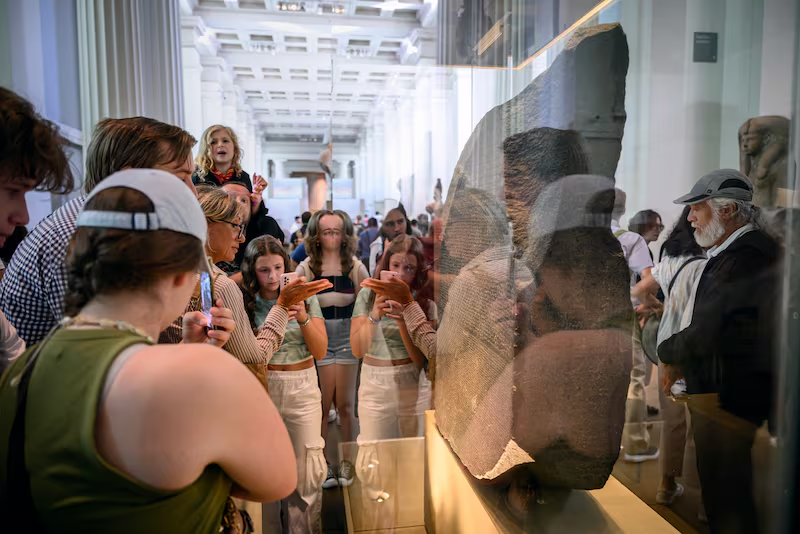
The Rosetta Stone remains one of the world’s most famous ancient artifacts and continues to be at the center of a long-running debate over cultural heritage. More than 220 years after it was taken to Britain, Egypt is renewing its efforts to bring the historic stone back to its country of origin.
This week marks 227 years since French forces discovered the Rosetta Stone near the Egyptian city of Rashid during Napoleon Bonaparte’s military campaign in Egypt. The discovery became one of the most important moments in the study of ancient Egyptian history because it later helped scholars unlock the meaning of hieroglyphic writing.
After French forces surrendered in 1801, the stone was transferred to British control under the Treaty of Alexandria. It was taken to London in 1802 and has remained on display at the British Museum ever since.
Today, Egypt continues to seek the artifact’s return. Former Egyptian antiquities minister Zahi Hawass is leading an international campaign that calls for the Rosetta Stone to be repatriated. A petition launched in 2022 has collected about 350,000 signatures, and Hawass has said he plans to expand the campaign once it reaches one million supporters.
The Rosetta Stone is considered one of the most valuable archaeological discoveries because it contains the same text written in three different scripts. This unique feature allowed researchers to compare the languages and eventually understand ancient Egyptian hieroglyphs.
The stone dates to 196 BC during the reign of King Ptolemy V. It is part of a larger granodiorite stele, a stone monument used to display official texts and royal decrees. The surviving section stands just over one meter tall.
Its name comes from Rosetta, the European name for the Egyptian city of Rashid, where it was discovered. In Arabic, it is known as Hajar Rashid, which means the Stone of Rashid.
The inscription appears in three writing systems. The top section uses Egyptian hieroglyphs, which were mainly used for temples, monuments, and religious texts. The middle section is written in Demotic, a script used for everyday administration, trade, and legal documents. The bottom section is written in Ancient Greek, which served as the official language of the Ptolemaic government.
The text itself records a decree issued by Egyptian priests praising King Ptolemy V. It highlights his support for temples, mentions tax reductions, and celebrates his leadership. Although the message honored the young ruler, historians view it as an official political declaration rather than a religious document.
For centuries, scholars were unable to read hieroglyphs because knowledge of the writing system had gradually disappeared after ancient Egyptian temples closed. The breakthrough came in 1822 when French scholar Jean-Francois Champollion successfully deciphered the script.
Using his understanding of Coptic, the final historical stage of the Egyptian language, Champollion connected hieroglyphic symbols with spoken Egyptian words and sounds. His work transformed the study of ancient Egypt and opened the door to translating thousands of inscriptions found across the country.
The Rosetta Stone has since become a worldwide symbol of solving difficult puzzles and unlocking hidden knowledge. Its name is often used as a metaphor for discovering the key to understanding complex information.
The question of where the artifact should be displayed continues to generate debate. Visitors can currently view the original Rosetta Stone free of charge at the British Museum in London. Meanwhile, Egypt’s Rashid National Museum displays a replica for visitors.
Supporters of its return argue that the stone should be displayed in Egypt because it was discovered there and forms part of the country’s cultural heritage. Hawass has proposed that it be placed in the Grand Egyptian Museum in Giza, where many of Egypt’s most significant ancient treasures are exhibited.
Others involved in the Repatriate Rashid campaign believe the artifact should instead be housed in Rashid, the city where it was found and from which it takes its name.
Despite decades of discussion, no agreement has been reached on the Rosetta Stone’s future. As Egypt continues its campaign, the debate over cultural ownership, historical preservation, and the return of important artifacts remains an important issue in the international museum community.
