


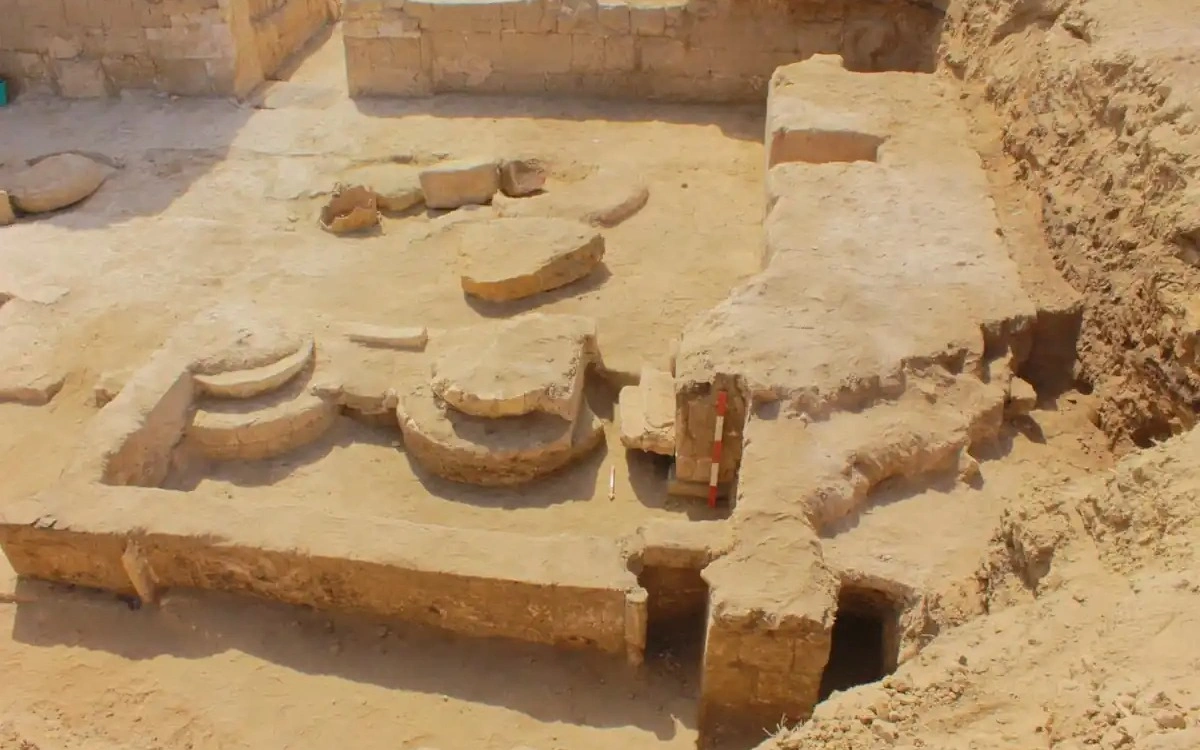
Archaeologists in Egypt have uncovered major remains of a 2,500-year-old temple in the Bahariya Oasis, shedding new light on the region’s long religious and administrative history.
The discovery was announced by the Egyptian Ministry of Tourism and Antiquities, following work by an archaeological mission from the Supreme Council of Antiquities. The team found structural remains, inscriptions, and artifacts linked to several ancient Egyptian rulers.
Among the most significant finds were sandstone blocks bearing the name and titles of King Psamtik I. Archaeologists also uncovered parts of a sandstone chamber, along with objects that suggest the site played a major role in religious and administrative life during multiple historical periods.
Officials said the discovery confirms that the site was not only a place of worship but also an important center of governance across successive dynasties. The findings help researchers better understand how desert oasis regions were integrated into the wider Egyptian state.
The excavation revealed a large hypostyle hall supported by 16 sandstone columns. The structure also includes adjoining rooms and smaller shrines, which were likely used for ritual activities and religious ceremonies.
Hieroglyphic inscriptions found at the site mention several major ancient Egyptian deities. These include Amun-Ra, Amunet, and Khonsu, all of whom played key roles in the religious belief system of ancient Egypt.
Researchers say construction of the temple hall began under King Psamtik I and was later completed during the reigns of Kings Wahibre, also known as Apries, and Ahmose II, also known as Amasis. This timeline suggests long-term use and continued development of the site over generations.
In addition to the temple structures, the mission uncovered a stone stela dating back to the reign of King Amenhotep II of the 18th Dynasty. This artifact indicates that the Bahariya Oasis had connections to the Egyptian state much earlier than previously confirmed.
Archaeologists also found objects associated with the era of King Ramesses II. These findings suggest that the area experienced sustained religious and urban activity even before the 26th Dynasty, pointing to continuous human presence over centuries.
Experts believe the discovery adds valuable insight into how desert oases contributed to Egypt’s political and religious systems. The site may have served as a strategic hub linking remote desert regions with central authority along the Nile Valley.
Further excavation work is expected to continue in the region as researchers aim to map the full extent of the temple complex. Scientists hope the findings will help reconstruct daily life, religious practices, and administrative structures from ancient Egypt’s Late Period and earlier dynasties.
