


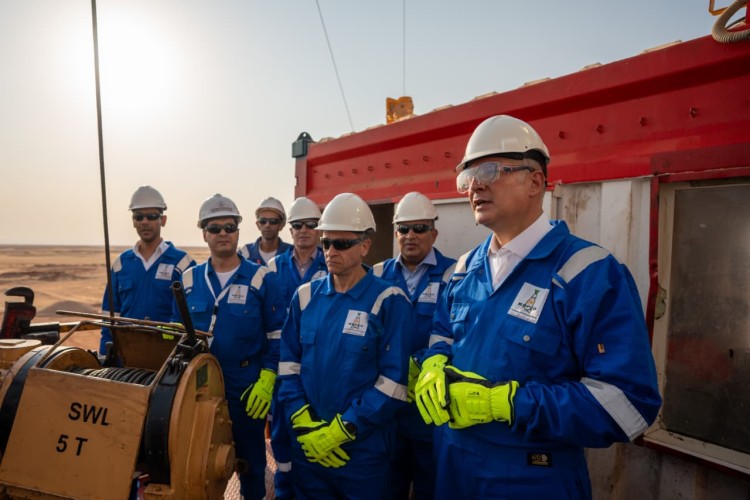
Egypt has resumed drilling operations at the Al Baraka oil field after a four-year pause, marking a new step in the country’s efforts to increase domestic oil production and attract energy investment.
The restart follows new funding from Canadian energy company Mediterra Energy, which is partnering with the South Valley Egyptian Petroleum Holding Company (GANOPE) to revive production in the Kom Ombo concession area.
Officials from Egypt’s Ministry of Petroleum and Mineral Resources confirmed that drilling and well rehabilitation activities are now underway at the Upper Egypt oil field.
Petroleum and Mineral Resources Minister Karim Badawi visited the site to review progress and oversee the relaunch of operations.
The return of drilling activity was made possible after the arrival of a new drilling rig and fresh investment designed to restore production from existing wells and support future exploration.
The Al Baraka field is located within the Kom Ombo concession, where Mediterra Energy operates alongside GANOPE. The Canadian company also holds interests in several concession areas in Sinai through partnerships with the General Petroleum Company.
According to GANOPE Chairman Samir Raslan, drilling operations resumed last month as part of a broader development program.
The plan includes workover operations on seven existing wells, the drilling of two new wells, and technical studies for five additional locations that may offer future production opportunities.
The studies are being carried out in cooperation with the Egypt Upstream Gateway, which is helping identify the most promising drilling targets.
The current initiative is part of a wider strategy launched in July to revive production at the Al Baraka field. The program focuses on improving output from mature wells while expanding exploration activities in surrounding areas.
Discovered in 2007, Al Baraka became the first oil field identified in Upper Egypt. Over time, production declined as the field matured, leading to efforts aimed at restoring production levels through investment and advanced field management.
Officials believe the latest program could help unlock additional hydrocarbon resources within the Kom Ombo concession and support Egypt’s long-term energy goals.
The Ministry of Petroleum and Mineral Resources is also pursuing a broader strategy to increase petroleum investment throughout Upper Egypt.
One major initiative involves an extensive seismic survey across southern Egypt covering approximately 100,000 square kilometers. The survey is expected to provide updated geological information that could reveal new exploration opportunities.
According to ministry officials, the new data will be evaluated and then offered to investors interested in developing future energy projects.
The government has also introduced measures to improve the attractiveness of upstream oil investments.
These include fiscal incentives, updated investment frameworks, and the integration of concession areas to improve project economics and encourage additional exploration spending.
Officials say such reforms are designed to create a more competitive environment for both domestic and international energy companies.
The ministry has also expressed support for Mediterra Energy’s plans to expand its activities in Egypt.
Government representatives noted that the company’s decision to increase investment followed progress in resolving financial obligations owed to foreign energy partners.
Authorities are now examining opportunities to expand and consolidate concession areas linked to Mediterra’s operations in order to improve long-term commercial performance.
Looking ahead, GANOPE is preparing to award six new exploration blocks in southern Egypt.
These areas include South Baraka, North Baraka, and Kharit, which are expected to be developed by Mediterra Energy and the General Petroleum Company.
An additional exploration block in the Red Sea is planned for energy company BP.
The combined investments for these projects are estimated at between $60 million and $70 million.
Officials believe the planned exploration work could support the development of new oil resources in frontier regions while helping strengthen Egypt’s domestic energy production.
The restart of operations at Al Baraka is viewed as an important step toward expanding exploration activity, attracting foreign investment, and supporting the country’s broader energy development strategy.
