


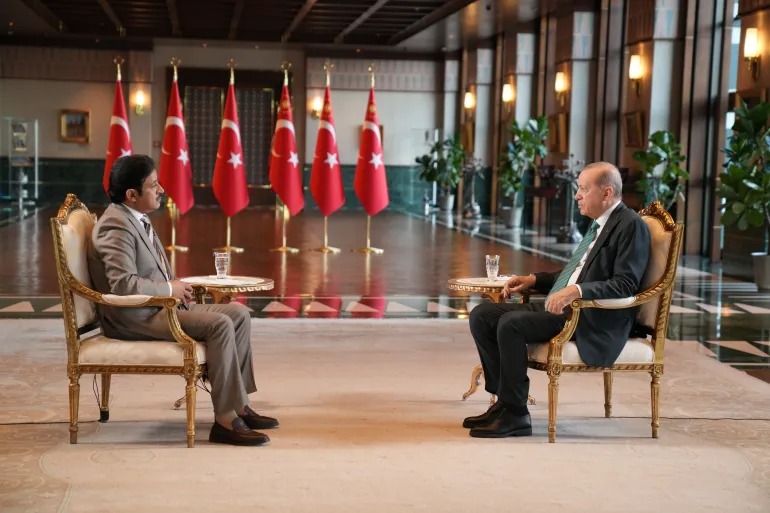
Turkish President Recep Tayyip Erdogan has said Egypt could join a new defence agreement signed by Turkiye, Saudi Arabia and Pakistan.
Erdogan described Egypt’s possible entry as an option for the pact’s future. He also said the agreement is open to more countries.
The Mecca Joint Defence Agreement was signed in Mecca on August 7. Erdogan signed it with Saudi Crown Prince Mohammed bin Salman and Pakistan Prime Minister Shehbaz Sharif. The pact says an armed attack on one member will be treated as an attack on all three.
The agreement is a major new step in regional security. It comes as the Middle East faces high military and political tension.
Erdogan said the pact sends an important message. He also said the group could grow if other countries choose to join.
Turkiye’s Foreign Minister Hakan Fidan has said the pact is not aimed at any one country. Pakistan has also described the agreement as defensive. Officials have warned against treating it as a direct copy of NATO, even though its main defence rule is similar to NATO’s Article 5.
The agreement also plans closer military ties. The three countries are expected to build new systems for political and military talks. They also plan joint exercises across land, sea, air and cyber areas.
Defence technology is another key part of the deal. The countries want more cooperation in areas such as drones, electronic warfare and artificial intelligence. They also want to support joint defence production and technology sharing.
Egypt could add major weight to the group if it joins.
Cairo has strong military ties with several countries. It also has an important role in Arab and African security. Egypt controls the Suez Canal, one of the world’s key trade routes, and has a large armed force.
Still, Egypt’s possible entry is not certain.
Reports have said Cairo has been cautious about joining the new pact. Egypt has security ties with several regional and Western powers. It must also balance its relations with Saudi Arabia, Turkiye and the United Arab Emirates.
The issue is important because the new pact comes during a period of wider regional change.
Erdogan also spoke about the Strait of Hormuz. He said reopening the waterway is a priority for Turkiye and argued that keeping it closed serves no one’s interests.
The strait is a key route for global energy trade. Any long closure can affect oil supplies, shipping costs and markets around the world.
The Turkish president also discussed conflicts in Syria, Gaza and Lebanon.
On Syria, Erdogan said Turkiye would continue to support stability. He also said Syria’s Kurdish population should have a share of peace and stability. Ankara has long been closely involved in Syria’s security and political affairs.
On Gaza, Erdogan said Turkiye would not leave the territory alone. He also said Hamas was meeting its commitments in good faith while Israel continued its military campaign.
Erdogan said the situation in Lebanon was another major concern. He said he had raised the need to end the fighting with US President Donald Trump.
He also said Turkiye would continue to support Sudan. On Libya, he described relations with Ankara as stable and said Turkiye would not abandon the country.
The Turkish president also spoke about Europe. He said the European Union did not appear ready to admit Turkiye. He added that EU membership was no longer a main goal for Ankara.
Another issue was Turkiye’s interest in the F-35 fighter jet program.
Turkiye was removed from the program in 2019 after buying Russia’s S-400 air defence system. Washington said the Russian system could put sensitive F-35 technology at risk.
Trump has said the United States could consider Turkiye’s return to the F-35 program. Erdogan said he had received a promise from Trump and was waiting for it to be fulfilled.
Any return would still face legal and political hurdles in Washington.
For now, the Egypt Turkiye Saudi Pakistan pact remains a three-country agreement. But Erdogan’s comments show that Ankara wants the door open for expansion.
If Egypt joins, the pact could become an even more important regional security framework. If it does not, the existing three members will still have to define how the agreement works in practice.
The next stage will show whether the pact becomes a lasting defence structure or remains mainly a political signal of closer regional cooperation.
