


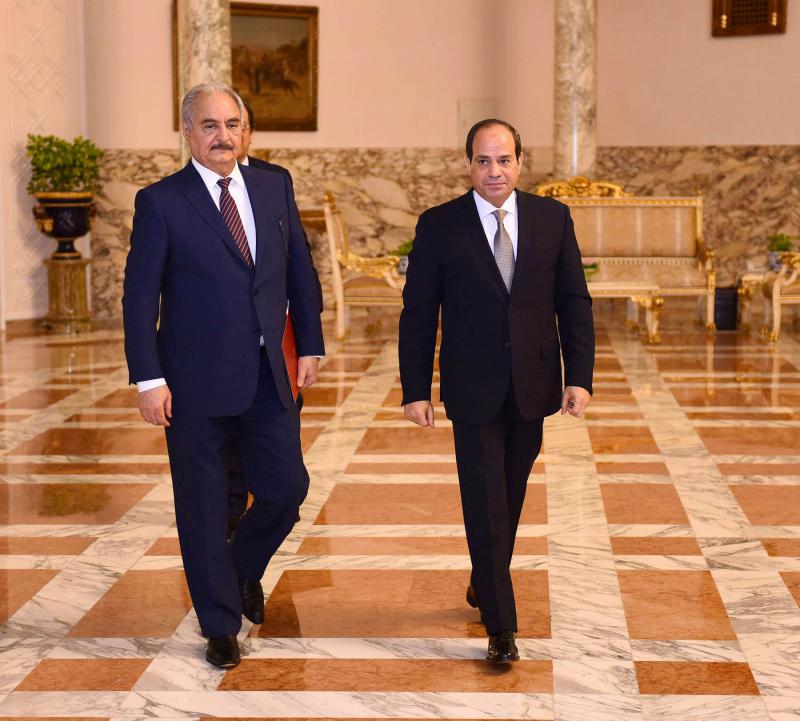
Egyptian President Abdel Fattah el-Sisi met Libyan military leader Khalifa Haftar in Cairo as Egypt renewed its focus on stability and security in neighboring Libya.
The meeting took place on Wednesday and included senior figures from the Libyan side. Haftar was joined by his son, Khaled Haftar, who serves as chief of staff of the Libyan National Army, and Saddam Haftar, who leads Libya’s reconstruction fund. Egypt’s intelligence chief Hassan Rashad also attended the meeting.
The talks come at an important time for Libya. The country remains split between rival political and military forces, despite years of efforts to create a stable national government.
Egypt has long viewed Libya as a major security concern. The two countries share a long border, and events inside Libya can have a direct effect on Egypt’s border security.
Cairo has also backed efforts to keep Libya united and to bring its divided institutions closer together.
The meeting with Haftar fits into that wider policy. Egyptian officials and political figures have described Libya’s stability as closely linked to Egypt’s own national security.
A senior Egyptian political figure said the meeting showed Cairo’s continued role in supporting stability in Libya. He also said the visit came at a sensitive time that requires close coordination between the two countries.
Haftar is one of Libya’s most powerful military figures. His forces control much of eastern Libya and have played a major role in the country’s long political struggle.
His visit to Cairo is therefore important for Egypt’s regional policy.
Egypt has maintained strong ties with eastern Libya for years. At the same time, Cairo has also supported efforts aimed at reaching political understandings between Libya’s rival sides.
The main challenge is building a political system that can bring together Libya’s divided institutions.
Libya has struggled with this problem since the fall of Muammar Gaddafi in 2011. Rival groups have competed for political power and control of state bodies. Armed forces have also remained divided across the country.
Egypt has repeatedly called for Libyan institutions to be united. It has also supported a political process that can lead to stronger state institutions and greater security.
The Cairo meeting also reflects Egypt’s wider interest in developments across North Africa.
Libya is important for Egypt for several reasons. It shares a border with Egypt, has large energy resources and plays a key role in regional migration routes. Stability in Libya can therefore affect Egypt’s economy and security.
For Haftar, close ties with Cairo can also provide an important regional connection.
The meeting did not immediately produce a new political deal for Libya. However, it showed that Egypt remains active in talks with major Libyan figures.
An international effort to bring Libya’s rival sides together has faced repeated delays. Political disagreements have made it difficult to hold national elections and create one stable government.
Egypt has said it supports a political solution that protects Libya’s unity and independence.
The latest meeting may also help Cairo understand the position of Haftar and his allies as Libya’s political situation develops.
Egypt’s role in Libya has often focused on security, border control and political stability. Cairo wants to avoid a new period of major fighting near its western border.
The Egyptian government has also stressed that Libya’s security is tied to wider Arab and regional security.
The visit therefore carries meaning beyond the meeting itself. It shows that Egypt continues to treat Libya as a key part of its foreign and security policy.
For Libya, the main task remains finding a path toward a unified state. For Egypt, the priority is a stable neighbor with secure borders and functioning institutions.
The coming months may show whether talks between Libya’s rival groups can make progress. Until then, Cairo is likely to keep engaging with the main political and military players in Libya.
The meeting with Haftar is another sign that Egypt intends to remain deeply involved in efforts to shape a more stable future for its western neighbor.
