


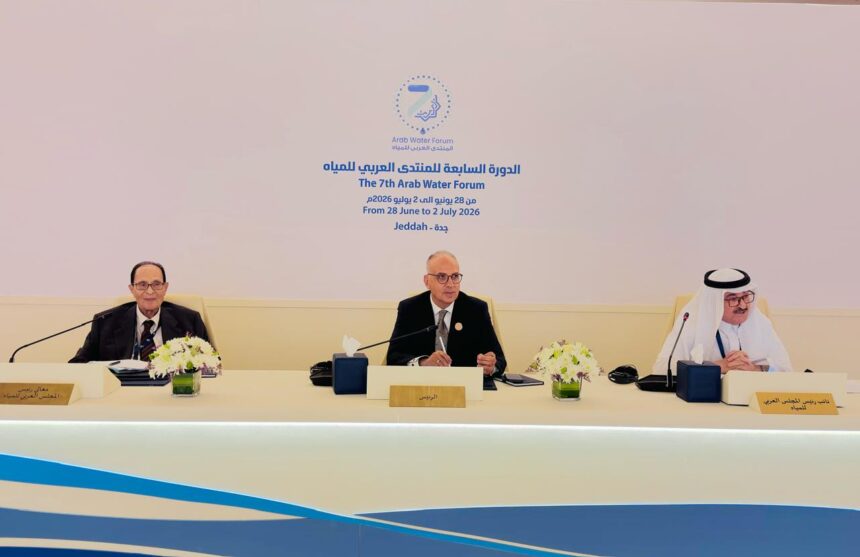
Egypt has called for the launch of jointly financed Arab water projects to strengthen regional water security while expanding cooperation with Saudi Arabia on sustainable water management and climate adaptation.
The proposal was presented by Egypt’s Minister of Water Resources and Irrigation, Hani Sewilam, during the Seventh Arab Water Forum, which was held as part of the first Saudi Water Week in Jeddah.
Speaking before ministers, senior government officials, and representatives of regional and international organizations, Sewilam said Arab countries need to move beyond policy discussions and focus on practical projects that can attract investment and deliver long-term results.
He said the growing challenges of water scarcity and climate change require stronger regional cooperation and better financial support for projects that improve water security across the Arab world.
Sewilam highlighted Egypt’s Water 2.0 program as an example of how countries can improve water management through modern technology and efficient resource use. The program focuses on increasing water-use efficiency, expanding non-traditional water sources, improving wastewater treatment and reuse, and using advanced digital technologies to monitor water resources.
He said the initiative also makes use of satellite imagery, drones, and early warning systems to support better planning and respond more effectively to water-related risks.
The minister pointed to several major Egyptian water treatment projects, including the Bahr El-Baqar, El-Mahsama, and New Delta plants. These facilities have expanded the country’s ability to recycle and reuse water for agriculture and other purposes.
During the forum, Sewilam proposed creating a regional list of investment-ready water and climate projects. He said the proposed initiatives could include agricultural desalination, wastewater reuse, digital water management, climate adaptation programs, early warning systems, and technical training.
He also encouraged Arab countries to make greater use of climate finance and funding from regional and international development institutions to support these projects.
According to Sewilam, strengthening Arab water security will require countries to share successful national experiences while improving cooperation through existing regional partnerships. He said increased investment would help transform shared priorities into projects that can deliver measurable benefits.
On the sidelines of the forum, Sewilam met with Saudi Minister of Environment, Water and Agriculture Abdulrahman Al-Fadley to discuss expanding bilateral cooperation.
The ministers reviewed progress made under a memorandum of understanding signed in 2022. The agreement covers cooperation in flood risk management, dam construction and maintenance, modern irrigation methods, sustainable water management, and climate adaptation.
Sewilam said technical cooperation between the two countries is already underway. Saudi specialists have visited Egypt to study the Bahr El-Baqar and New Delta water treatment facilities, while Egyptian experts have toured Saudi Arabia’s Shuaibah desalination plant to exchange technical knowledge.
The discussions also covered preparations for major international events. Both ministers reviewed coordination ahead of the 11th World Water Forum, which Saudi Arabia will host in Riyadh in 2027, as well as planning for the 2026 United Nations Water Conference.
Officials also explored future cooperation in agricultural desalination, smart water systems, digital technologies, groundwater recharge, and other advanced water management solutions designed to improve long-term sustainability.
At the conclusion of the meeting, Sewilam invited his Saudi counterpart to attend the Ninth Cairo Water Week. The event will also include meetings of the Arab Ministerial Water Council and the Arab Water Conference, bringing together regional leaders to discuss future water challenges and policy solutions.
The Arab Water Projects proposal reflects Egypt’s broader effort to encourage regional cooperation in addressing growing water and climate pressures. Officials say stronger partnerships, shared expertise, and increased investment will play a key role in improving water security and supporting sustainable development across the Arab region in the years ahead.
