


Egypt and a Chinese industrial group are advancing plans for a major new textile development project worth up to $2 billion, aiming to build what officials describe as a carbon-neutral industrial city focused on textiles and related manufacturing.
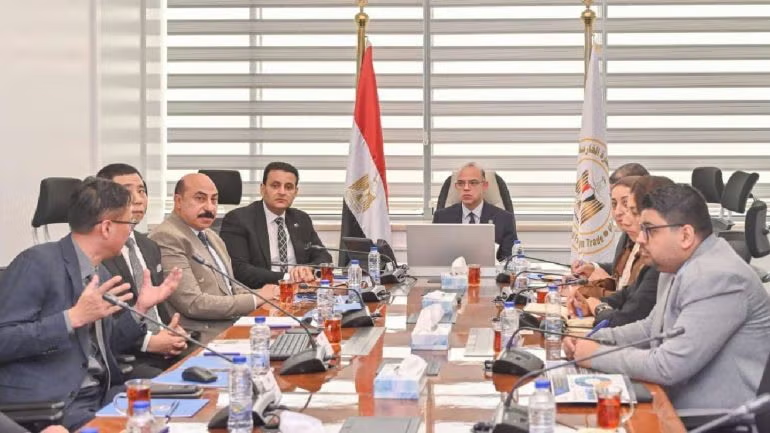
The proposal was discussed during a high-level meeting in Egypt between government representatives and executives from Cloud Chain, a Chinese company leading the project. The delegation included Cloud Chain chief executive Huang Wei and chief financial officer Xian Chun, along with senior officials responsible for marketing and external relations.
The project has been presented as the “Middle East and North Africa’s first integrated, carbon-neutral textile industrial city,” reflecting growing efforts to combine large-scale industrial expansion with sustainability goals.
According to the plan, the development will cover a total area of 4.5 million square meters and will be built in two phases over several years. Each phase is expected to take around 24 months to complete.
The first phase will span 2 million square meters and focus on establishing fully integrated industrial and service facilities. This stage is expected to host between 30 and 50 textile companies, alongside vocational and technical training institutions, logistics hubs, and commercial infrastructure.
The second phase will expand the project by an additional 2.5 million square meters. This stage is designed to complete the industrial ecosystem by linking manufacturing operations with supporting industries and supply chains, strengthening long-term production capacity.
Cloud Chain estimates the total investment for the project at between $1.5 billion and $2 billion. The company says Egypt offers a strategic location for accessing both African and Middle Eastern markets, making it an attractive hub for export-oriented industrial development.
The project is also projected to generate significant employment opportunities. Estimates suggest it could create between 50,000 and 80,000 direct jobs, along with approximately 60,000 indirect jobs across supporting services, logistics, and supply chains.
Egyptian officials have emphasized that the country’s geographic position, infrastructure development, and wide network of trade agreements make it well-suited for large-scale industrial investment. They say these factors are central to the government’s broader strategy to attract foreign direct investment and expand value-added manufacturing.
During the meeting, officials also highlighted the government’s ongoing efforts to improve the investment climate, particularly for industrial zones and export-driven projects. They stressed the importance of building partnerships that support long-term economic growth and job creation.
As part of the discussions, the Egyptian side instructed relevant agencies to organize field visits for the Chinese delegation to several industrial and investment zones. These visits are intended to help assess infrastructure capacity and identify suitable development sites for the project.
Officials also committed to continued technical coordination with Cloud Chain through Egypt’s commercial representation in China. This includes evaluating feasibility studies and ensuring that planning aligns with national industrial development priorities.
Both sides discussed possible investment structures, including specialized economic zones designed to support large industrial projects. These frameworks are expected to help streamline development and provide regulatory support for foreign investors.
The initiative reflects Egypt’s broader ambition to position itself as a regional manufacturing hub, while also aligning with global trends toward lower-emission industrial production. If completed, the project would mark one of the largest textile-focused industrial developments in the region.
