


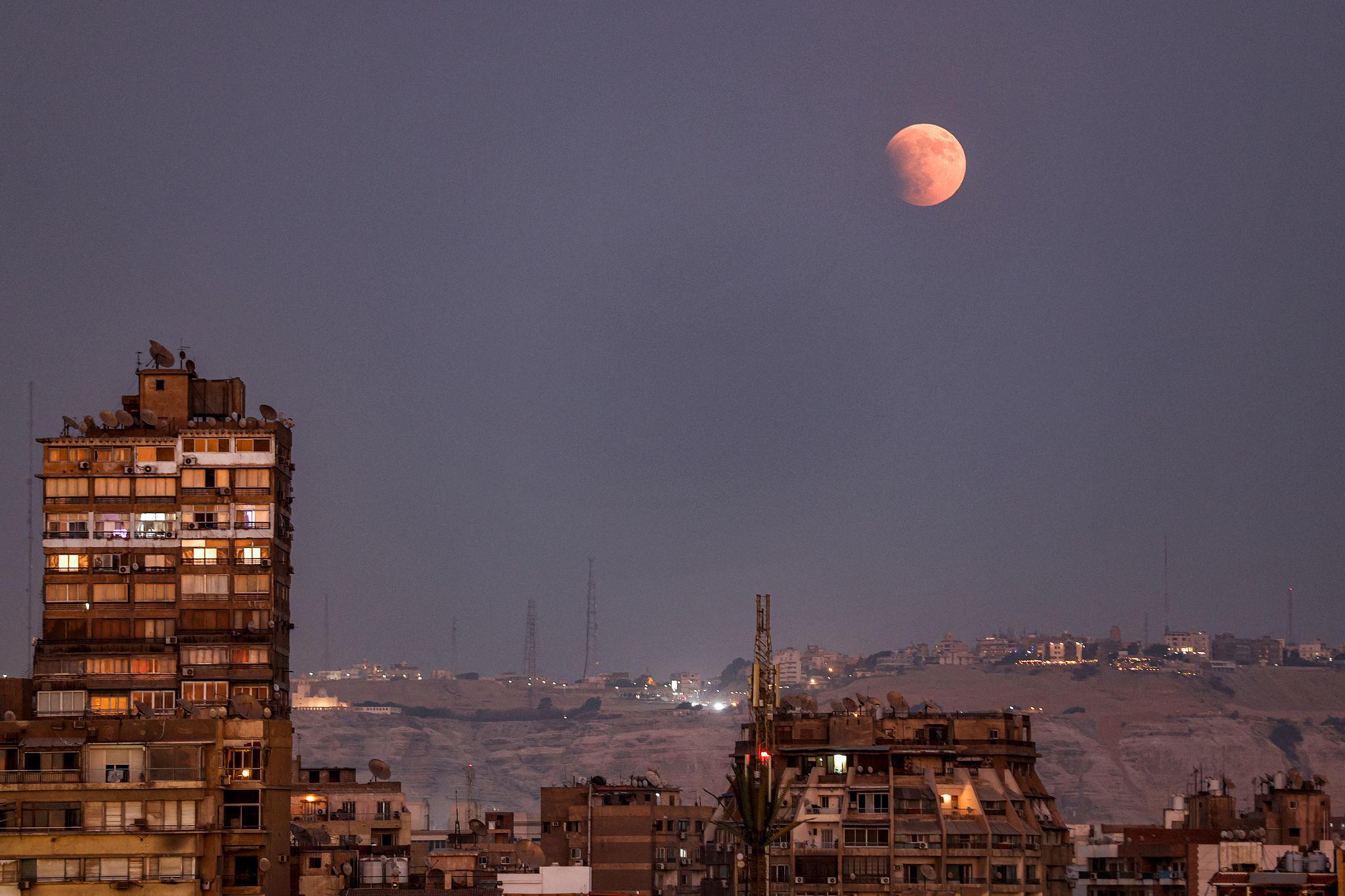
People across Cairo and parts of Egypt had a chance to see a rare sky event early on Friday, August 28, 2026. A partial lunar eclipse took place as the Moon moved into Earth’s shadow. The event was visible in Cairo during the early morning hours, giving sky watchers a chance to see part of the Moon turn darker and redder before sunrise.
In Cairo, the eclipse began with the Moon entering the lighter part of Earth’s shadow at about 4:23 am local time. The partial stage began at about 5:33 am, when the darker shadow started to cover part of the Moon. The event reached its strongest visible stage in Cairo at about 6:28 am, according to detailed local eclipse data.
The event was not a total lunar eclipse. During a partial eclipse, only part of the Moon enters the darkest part of Earth’s shadow. This can make the covered part look dark red, brown or copper in color. The color comes from sunlight passing through Earth’s atmosphere before reaching the Moon.
The timing made the event especially important for observers in Cairo. The Moon was already low in the western sky as the eclipse reached its peak. The partial stage began at 5:33 am, while the Moon was still above the horizon. As morning light increased, viewing conditions became harder.
The National Research Institute of Astronomy and Geophysics said Egypt would witness the early stages of the deep partial eclipse on Friday. The institute’s information placed the event in the early hours before sunrise. This meant that people needed a clear view toward the western part of the sky to see the Moon during the event.
The eclipse was also visible from other parts of the country. New Cairo and several areas in the Greater Cairo region had similar viewing times. In New Cairo, the eclipse began at about 4:23 am and reached its maximum around 6:28 am. The Moon remained above the horizon during the key early stages.
For viewers, no special equipment was needed to look at a lunar eclipse. Unlike a solar eclipse, a lunar eclipse can be viewed safely with the naked eye. Binoculars or a small telescope can make the Moon’s surface and the changing shadow easier to see, but they are not required.
The August event also drew wider interest because the eclipse covered a large part of the Moon. Astronomical information for the event said close to the full Moon would enter Earth’s darkest shadow during the global eclipse. However, the exact amount visible from Cairo was limited by the Moon’s position and its setting time.
The eclipse gave Cairo residents a brief chance to see a striking natural event before the city began its normal morning activity. With the Moon low in the western sky and daylight approaching, the viewing window was short. For astronomy fans, August 28 became a notable date in Egypt’s 2026 sky calendar.
