


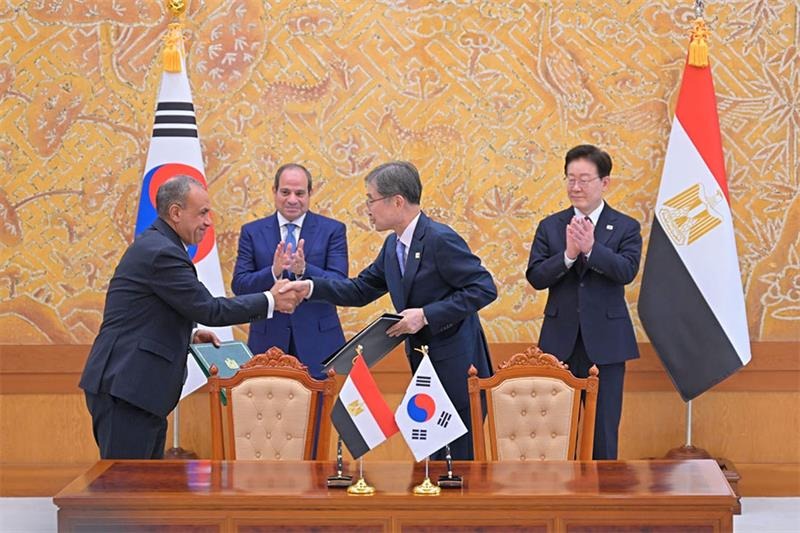
Egypt and South Korea are seeking closer cooperation in trade, industry and regional affairs as President Abdel-Fattah El-Sisi visits Seoul for talks with South Korean President Lee Jae Myung. The meetings reflect efforts by both countries to strengthen their relationship and identify new areas for economic cooperation. The visit has also brought attention to Egypt’s concerns over water security and the wider stability of the Middle East.
During the talks, El-Sisi described the Nile River as an existential issue for Egypt. The river is a central source of water for households, farms and industry, making its future a major national concern. Egypt has repeatedly stressed that any arrangements affecting the Nile must take account of the needs of the people who depend on it. The issue remains closely linked to food security, economic development and long-term planning.
The discussions also covered the relationship between Egypt and South Korea. Both governments are interested in expanding cooperation in sectors where South Korean companies have experience, including manufacturing, technology, energy and transport. Egypt hopes that greater investment will help develop local industries, create jobs and reduce dependence on imported finished goods.
South Korea is an important industrial economy with expertise in vehicles, electronics, shipbuilding and advanced manufacturing. Egypt, meanwhile, offers access to markets in Africa and the Middle East and has been seeking investment that can support its industrial development. Stronger commercial links could create opportunities for companies in both countries, although the results will depend on specific projects and agreements.
Regional security was another important part of the discussions. El-Sisi stressed that responsibility for the security and governance of the Red Sea rests with the states along its shores. The waterway is vital for international shipping, trade and energy transport. Instability in the region can affect commercial routes and raise concerns for countries that rely on safe passage through the area.
The visit comes as Egypt continues to balance domestic economic needs with diplomatic responsibilities across the region. Investment, employment and industrial growth remain key challenges, while water security and regional conflict require sustained attention. Cooperation with South Korea could provide practical benefits if political discussions lead to projects with clear goals and long-term funding.
Officials have presented the meetings as an opportunity to deepen relations, but agreements must be followed by implementation. Businesses will look for clear rules, stable conditions and reliable partnerships before making major investments. Public agencies will also need to coordinate so that proposed projects meet national development priorities.
The talks show how Egypt is seeking to connect diplomacy with economic planning. Stronger ties with South Korea may support industrial development and technical cooperation, while the discussions on the Nile and Red Sea underline the importance of security to Egypt’s wider interests. The next stage will depend on how both governments turn their discussions into practical work.
