


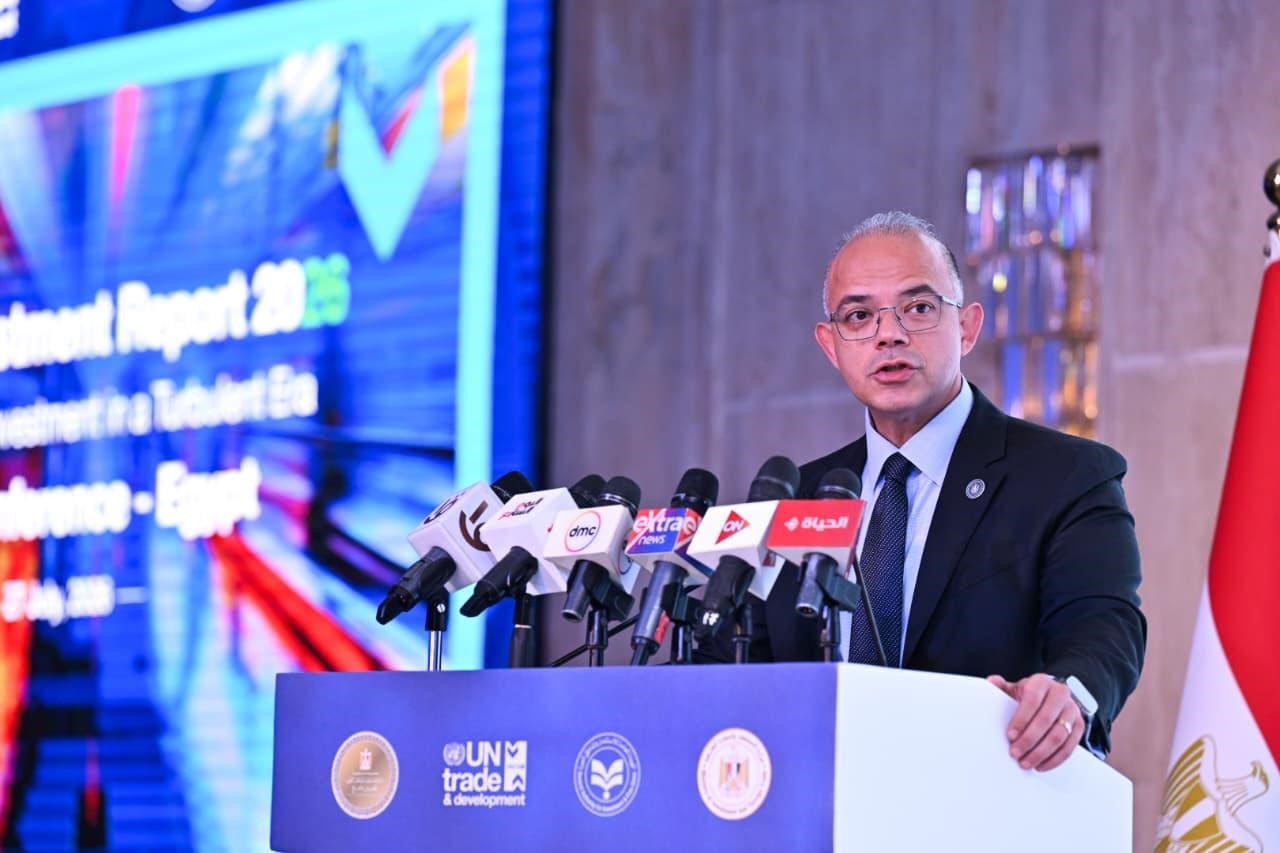
Egypt attracted $15.5 billion in foreign direct investment (FDI) during 2025, making it the largest recipient of foreign investment in Africa and the second-largest destination in the Arab world, according to government officials.
The announcement was made by Minister of Investment and Foreign Trade Mohamed Farid during the launch of the United Nations Conference on Trade and Development (UNCTAD) World Investment Report 2026 in Cairo. The event brought together senior government officials, business leaders, representatives of international financial institutions, and regional organizations to discuss investment trends and economic development.
Farid said the government is finalizing a new national investment strategy designed to attract more foreign capital and strengthen Egypt’s position as a leading investment destination. The strategy focuses on 12 priority economic sectors.
According to the minister, eight of these sectors are considered ready to attract investment in the near term due to existing opportunities and market readiness. The remaining four sectors will require additional legislative and regulatory reforms before they can reach their full investment potential.
The government is also preparing a series of new measures aimed at making it easier for companies to operate and expand in Egypt. Farid announced that a package of decisions and procedures will be introduced in the coming weeks to simplify capital increases, mergers, and acquisitions.
The new measures will be supported by an integrated digital system designed to reduce processing times and improve the quality of services provided to investors. Officials believe the digital approach will make business operations faster, more transparent, and more efficient.
Another major initiative is the development of the Economic Entities Platform, which has already received cabinet approval. The platform is intended to create a single digital gateway for company registration and licensing procedures.
Currently, the platform covers 468 economic activities and is expected to expand further in the future. The system is being developed through the integration of government databases and digital infrastructure to reduce administrative burdens and improve the investment experience.
Farid said these efforts are part of broader structural and institutional reforms aimed at creating a more competitive business environment. The government continues to focus on increasing transparency, encouraging private sector participation, and attracting productive investments that support economic growth and job creation.
Minister of Foreign Affairs, Emigration and Egyptian Expatriates Badr Abdelatty highlighted the country’s ongoing economic reform program and efforts to strengthen economic resilience. He pointed to improvements in macroeconomic indicators and emphasized the role of the private sector as a key driver of growth.
Abdelatty noted that Egypt has introduced several measures to encourage investment, including the State Ownership Policy Document and limits on government investments in selected sectors to create greater opportunities for private businesses.
He also highlighted tax and customs incentives offered in strategic sectors such as renewable energy, automotive manufacturing, pharmaceuticals, logistics, information technology, and artificial intelligence.
According to Abdelatty, Egypt’s strong investment performance reflects growing confidence among international investors. He said retaining the position of Africa’s leading destination for foreign direct investment for a second consecutive year demonstrates the success of ongoing reforms.
The UNCTAD World Investment Report 2026 also provided insight into global investment trends. Farid said the report reflects major shifts in the global economy as countries and businesses respond to geopolitical tensions and trade policy uncertainty.
He noted that investment linked to industrial activities and value-added production chains has faced pressure in several regions. At the same time, many governments are implementing reforms aimed at improving investment environments by simplifying regulations and increasing transparency.
Pedro Manuel, Acting Secretary-General of UNCTAD, said global foreign direct investment increased by 6 percent in 2025 to approximately $1.6 trillion. However, when certain financial transactions linked to European financial centers are excluded, real growth was closer to 4 percent.
The report showed significant differences across regions. Developed economies recorded investment growth of 11 percent, reaching $723 billion. Developing economies grew by 2 percent to $901 billion, while developing Asia remained the world’s largest investment destination with $644 billion.
Africa received approximately $70 billion in foreign direct investment during the year. Although the continent attracted substantial capital, Farid said Africa did not fully benefit from overall global investment growth.
UNCTAD officials noted that investment is increasingly concentrated in strategic sectors such as semiconductors, artificial intelligence, clean energy, and critical minerals. Investments in these industries have increased more than fivefold since 2020, reaching about $580 billion globally.
Officials also said shifting global supply chains present new opportunities for developing economies. Countries that invest in infrastructure, workforce skills, and regional cooperation could attract more manufacturing projects and become important hubs in emerging global value chains.
As Egypt advances its reform agenda and expands digital services for investors, government leaders believe the country is well positioned to attract additional investment, strengthen private sector growth, and support long-term economic development.
