


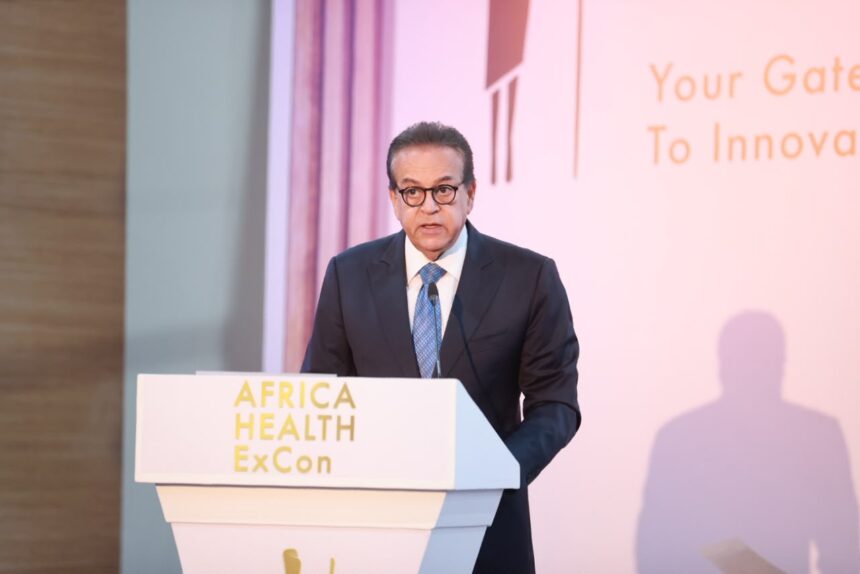
Egypt has called for stronger and more independent healthcare systems across Africa, with Health Minister Khaled Abdel Ghaffar stressing that achieving African health sovereignty has become a strategic necessity rather than an option. His remarks came during the fifth edition of Africa Health ExCon 2026 in Cairo, where leaders gathered to discuss the future of healthcare on the continent.
Speaking at the opening session titled “African Health Sovereignty: From Dependency to Strategic Independence,” Abdel Ghaffar said African countries must be able to protect public health, respond quickly to medical emergencies, and develop local production of essential medicines and health products. At the same time, he emphasized that international partnerships remain important for long-term progress.
The minister presented Egypt’s healthcare reforms as a model for other African nations. He highlighted the country’s universal health insurance programme, which has already completed its first phase in six governorates. The second phase is expected to extend coverage to an additional 18 million citizens, expanding access to healthcare services across the country.
Abdel Ghaffar also pointed to Egypt’s “100 Million Healthy Lives” initiative as a major success story. The programme played a key role in eliminating hepatitis C as a public health threat in Egypt through widespread screening and treatment campaigns. He said Egypt is ready to share its experience with other African countries, particularly in prevention and early detection strategies.
He further emphasized Egypt’s role in supporting African partners during health emergencies. He noted that Cairo has provided assistance to countries such as the Democratic Republic of Congo and Uganda during Ebola outbreaks. This support included medicines, protective equipment, and doses of locally produced remdesivir, supplied under directives from President Abdel Fattah Al-Sisi.
A major focus of the minister’s address was pharmaceutical security and local manufacturing. He noted that Egypt is the only African country to achieve the World Health Organization’s Maturity Level 3 certification for the regulation of both medicines and vaccines. According to him, this positions Egypt as a regional leader capable of supporting technology transfer and strengthening pharmaceutical production across Africa.
Beyond public health systems, Abdel Ghaffar also discussed the growing importance of medical tourism. In a separate panel titled “Connecting Continents and Transforming Health Tourism,” he said the sector has evolved into a full industry that integrates high-quality medical care with tourism services and streamlined patient experiences.
He said Egypt has already established a National Council for Medical Tourism and is developing a digital platform that will guide international patients through every stage of treatment, from booking services to post-treatment travel. He described medical tourism as a promising economic sector that can strengthen the national economy while enhancing Egypt’s global healthcare reputation.
The minister also called for unified standards across the medical tourism industry to ensure quality, sustainability, and international competitiveness. He said Egypt aims to position itself as a leading destination for both healthcare and tourism by combining advanced medical services with strong infrastructure.
During the conference, Abdel Ghaffar received the “Outstanding Health Personality of the Year 2026” award in recognition of his contributions to healthcare development. Other awards were presented to regional health leaders for strengthening system resilience and advancing cooperation in the sector.
On the sidelines of the event, Abdel Ghaffar also held talks with Danish Ambassador to Egypt Lars Bo Moller and representatives of Danish healthcare companies. Discussions focused on expanding cooperation in medical technology, digital transformation, and healthcare investment.
According to Egypt’s Health Ministry, the meeting also explored opportunities for Danish investment in Egypt, technology transfer, and local manufacturing partnerships. Officials said these initiatives aim to strengthen Egypt’s position as a regional hub for medical industries.
Ambassador Moller praised Egypt’s progress in healthcare and reaffirmed Denmark’s commitment to expanding cooperation with Cairo. He said both countries share a strong interest in developing partnerships that support innovation and improve health systems.
Egypt’s message at Africa Health ExCon 2026 reflected a broader push toward self-reliance in healthcare, regional cooperation, and global engagement through medical tourism and innovation.
