


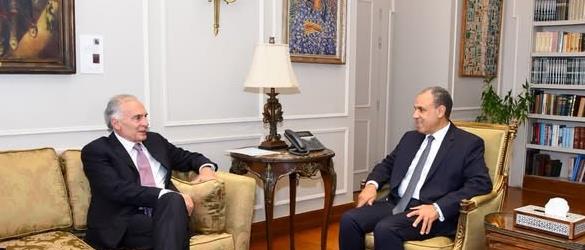
Egypt’s Foreign Minister Badr Abdelatty has held talks with Jean Arnault, the Personal Envoy of the UN Secretary-General for the Middle East, focusing on efforts to reduce rising tensions in the region and support stability.
The meeting took place on Monday, April 20, 2026, during Arnault’s regional tour. Discussions centered on Egypt’s diplomatic role in easing conflicts and promoting de-escalation across the Middle East.
According to Egypt’s Foreign Ministry spokesperson Ambassador Tamim Khalaf, Abdelatty congratulated Arnault on his new appointment. He also expressed Egypt’s readiness to work closely with the United Nations to reduce tensions and support security and development in the region.
A key topic of discussion was Egypt’s ongoing mediation efforts between the United States and Iran. These efforts aim to build understandings that could lead to a ceasefire and reduce regional instability. Egyptian officials stressed that dialogue remains essential for resolving disputes.
Abdelatty warned that continued conflict in the region could have serious global effects. He pointed to risks for international trade, food security, energy supplies, and freedom of navigation. He said ending hostilities quickly is important to prevent wider economic and humanitarian damage.
Egypt also expressed support for continued diplomatic talks between the United States and Iran. The minister emphasized the importance of a second round of negotiations to strengthen any ceasefire arrangements and move toward longer-term stability.
The UN envoy praised Egypt’s diplomatic role in regional affairs. He highlighted Cairo’s efforts to support peace initiatives and reduce escalation risks. He also reaffirmed the United Nations’ support for Egypt’s engagement in restoring stability in the Middle East.
Both sides agreed to maintain close coordination and regular consultation on regional developments. They emphasized the importance of continued diplomatic engagement to address ongoing security challenges in the Middle East.
Egypt has positioned itself as an active mediator in several regional conflicts in recent years. Its diplomatic efforts often focus on reducing tensions and encouraging dialogue between conflicting parties. Officials say this approach is aimed at supporting both regional stability and global economic security.
The latest talks reflect growing international attention on Egypt’s role in regional diplomacy. As tensions continue in parts of the Middle East, countries and international organizations are increasingly relying on dialogue-based solutions.
With ongoing instability affecting multiple sectors, including trade and energy, both Egypt and the United Nations stressed the importance of sustained cooperation. They agreed that diplomatic efforts remain the most effective path toward long-term peace and stability in the region.
