


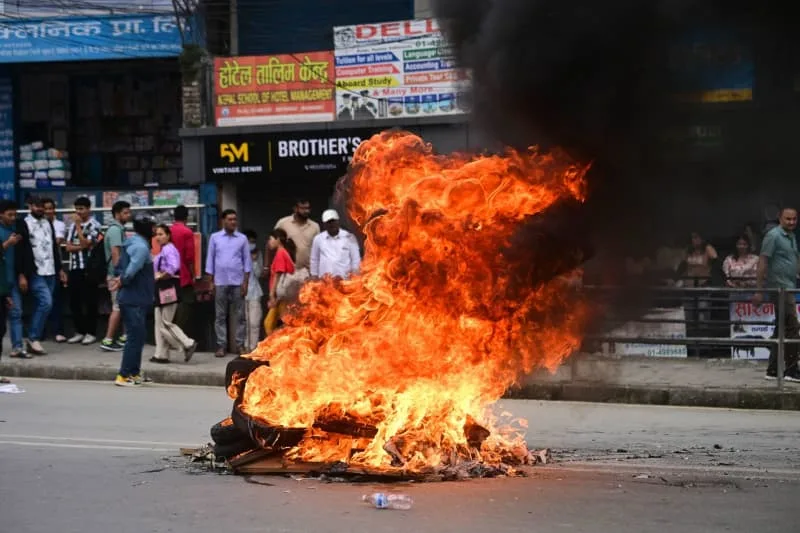
Nepal’s prime minister has resigned following deadly protests triggered by a controversial social media ban. KP Sharma Oli submitted his resignation to President Ram Chandra Paudel on Tuesday. Officials said the move aims to create a path for a political solution to the escalating unrest.
The government lifted the social media ban after a late-night cabinet meeting. Prithvi Subba Gurung, the communication, information, and technology minister, confirmed the withdrawal of the ban. The measure had blocked 26 online networks, including Facebook and Instagram, citing registration violations.
Despite nationwide curfews, protests continued into Tuesday morning. Thousands of demonstrators took to the streets, attacking political offices and leaders’ homes. The office of Nepali Congress was set on fire, and opposition leader Pushpa Kamal Dahal’s residence was attacked. Several other politicians also faced threats and vandalism.
Clashes between protesters and police were reported in Kathmandu Valley and across other regions. Police confirmed that at least 19 people were killed and about 150 injured. The violence followed growing discontent with the Oli government over corruption and nepotism allegations, which had been widely criticized on social media even before the ban.
Agriculture Minister Ramnath Adhikari also resigned on Tuesday. Local reports suggest several other ministers in Oli’s cabinet may step down, further signaling political instability.
The unrest comes after the Supreme Court of Nepal ordered in August that online services be placed under state supervision. Authorities said the step was necessary to control the spread of misinformation. Critics, however, argue that the government was using the ban to expand control over social media rather than to regulate it fairly.
The protests have raised questions about government accountability and the balance between regulation and freedom of expression. Analysts say the resignation could open the way for a political compromise to restore stability.
Nepal has faced increasing political turmoil in recent years, with repeated disputes over governance, corruption, and public accountability. The recent unrest underscores public frustration with perceived abuses of power and a lack of transparency.
The social media ban, although intended to enforce state oversight, ignited broader anger against the government. Demonstrators demanded immediate resignations and reforms, reflecting growing public impatience with political elites.
Security forces struggled to control the crowds, with police offices also targeted in several areas. Observers noted that the violence was largely concentrated in urban centers but had echoes across rural districts, highlighting nationwide discontent.
As Nepal seeks a path forward, political leaders face pressure to engage in dialogue with protesters and address systemic issues that have fueled unrest. The resignation of the prime minister marks a significant turning point in Nepalese politics, signaling a possible shift toward compromise and stability.
Authorities continue to urge calm, while social media platforms are expected to resume normal operations. Analysts say how the government handles this crisis could shape public trust and political legitimacy in the coming months.
