


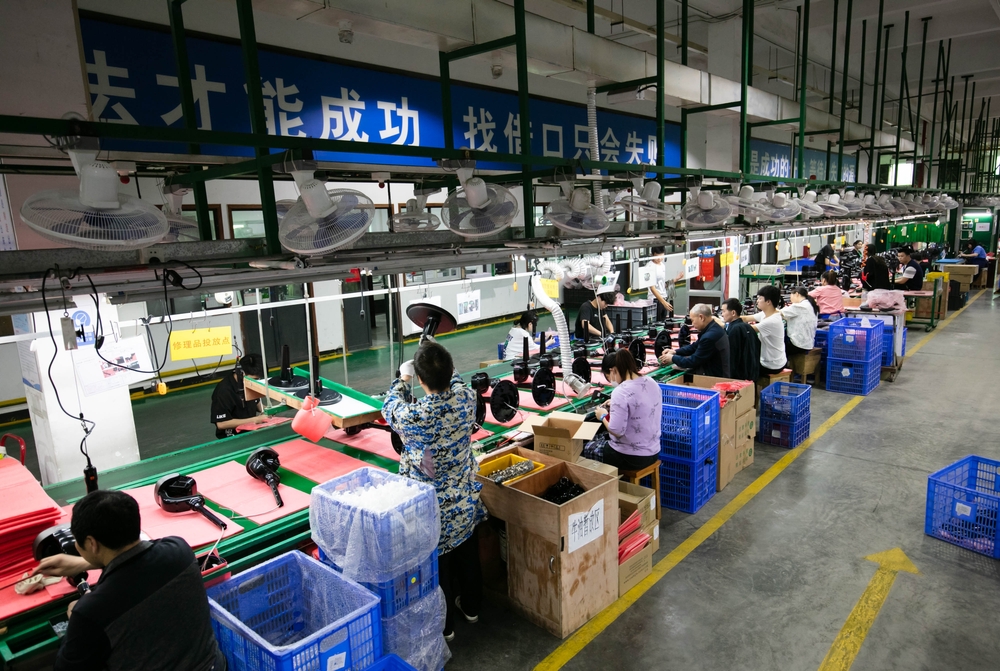
China drives a fresh export surge that threatens Europe’s economy, and Goldman Sachs warns of GDP losses in Germany, Italy, France, and Spain as competition intensifies and EU policies falter.
European economies face growing pressure as Beijing renews its export-led push and expands its global footprint.
Goldman Sachs issues several reports that lower European growth forecasts in response to China’s accelerating export wave.
Giovanni Pierdomenico states that increased Chinese supply damages the euro area by widening its trade deficit and weakening its competitive position.
He predicts that rising Chinese competition will cut euro area output by roughly 0.5% by late 2029.
The bank estimates that Germany absorbs the heaviest blow, with GDP projected to fall about 0.9% within four years.
It expects Italy to lose about 0.6% and France and Spain to drop around 0.4% each.
The scale of substitution between Chinese and European goods deepens Europe’s discomfort during this shift.
Goldman Sachs calculates that eurozone exporters have surrendered up to four percentage points of market share to China over the past five years.
For every additional dollar China exports, European shipments usually fall by twenty to thirty cents.
This substitution pattern steadily weakens Europe’s competitive strength.
Europe’s Limited Room to Respond
The EU launches programmes meant to reinforce economic resilience, including the Critical Raw Materials Act and the AI Continent Action Plan.
Goldman Sachs questions their impact and highlights Europe’s own strategic weaknesses.
Filippo Taddei argues that Europe struggles to respond because structural vulnerabilities limit its choices.
Analysts stress that Europe depends on China for key inputs, restricting broad efforts to curb Chinese supply.
They warn that targeted actions remain possible, but sweeping measures risk colliding with Europe’s reliance on critical raw materials.
They note that Europe continues to face long-standing dependence on foreign suppliers despite recent policy efforts.
They also caution that existing funding falls short of political ambitions, casting doubt on Europe’s ability to rebuild competitiveness.
Experts claim that a timid EU response could hasten the erosion of Europe’s industrial capacity as Chinese firms widen their global reach.
They also warn that an aggressive stance, including broad tariffs or sweeping import limits, could disrupt supply chains that Europe still needs.
Europe’s Industrial Choices Ahead
Goldman Sachs highlights defence as the only field where Europe allocates meaningful financial support.
The bloc’s Readiness 2030 programme, supported by €150 billion in loans through the Security Action for Europe scheme, contrasts with slower or underfunded initiatives in other areas.
Yet Europe still depends on Chinese raw materials to advance its defence goals, including rare earths required for drones, sensors, electronics, and weapons systems.
Goldman Sachs concludes that Europe risks losing ground in once-dominant sectors without a unified and forceful industrial strategy.
Its economists avoid calling for protectionism but leave leaders with urgent questions about Europe’s industrial direction.
They ask whether Europe can achieve the sovereignty it pursues and how long it can rely on fiscal support and consumer strength to endure global headwinds.
