


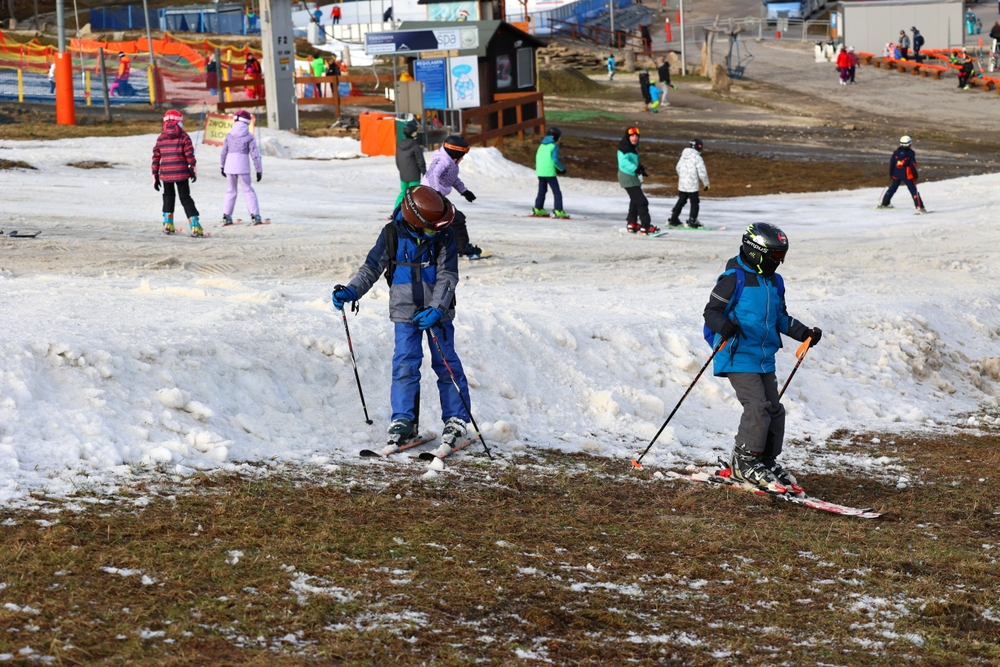
Rising temperatures and increasingly unreliable snowfall are forcing ski resorts across Europe to rethink how they survive. While the slopes around Cortina d’Ampezzo are currently white ahead of the Winter Olympics in Milan-Cortina this February, such conditions are becoming the exception rather than the rule.
Across much of Europe, snow now falls less often and melts sooner. Even where skiing is still possible, it often depends on artificial snowmaking — a costly solution that puts pressure on water resources, drives up energy use, and ultimately makes ski holidays more expensive and less accessible.
Winter Olympics Under Climate Pressure
Climate change is no longer a distant concern for winter sports. The International Olympic Committee has acknowledged that warming temperatures, largely driven by fossil fuel use, are reshaping where and how the Winter Games can be held.
A 2021 study by the University of Waterloo found that, without rapid action to curb global warming, only four past Winter Olympic host locations would still be suitable by mid-century: Lake Placid, Lillehammer, Oslo and Sapporo. In a worst-case scenario where global temperatures rise by 4°C by 2050, only Sapporo could still host the Games by 2080. Even if the Paris Agreement’s 2°C target is met, fewer than half of previous host sites would remain viable in the coming decades.
These challenges extend far beyond a single sporting event. For communities that depend on winter tourism, the effects are already being felt year after year.
Europe’s Heavy Dependence on Winter Tourism
Europe’s winter tourism industry generated around €180 billion in 2022, with the Alps at its core. The region spans several countries, supports millions of residents, and plays a critical role in water supply and biodiversity.
Germany leads Europe in the number of ski resorts, followed by Italy and France. But a 2023 study in Nature Climate Change paints a bleak picture: under a 2°C warming scenario, more than half of Europe’s 2,234 ski resorts face a very high risk of insufficient snow. In the French Alps, one in three resorts could become unviable, while in the Pyrenees nearly nine out of ten are at risk. If temperatures rise by 4°C, almost all European ski resorts would struggle to operate.
Rising Costs, Water Strain and Fewer Skiers
Artificial snow has become a lifeline for many resorts, but it comes at a steep price. Producing just 30 centimeters of snow on one hectare of slope can require around one million liters of water. Across the Alps, snowmaking also demands vast amounts of electricity, contributing to greenhouse gas emissions that worsen the climate crisis.
Supplying artificial snow to Alpine resorts alone could consume about 600 gigawatt-hours of electricity each year — roughly the annual usage of 130,000 households. These costs are increasingly passed on to visitors. Since 2015, the price of skiing in Europe has risen by nearly 35 percent, far outpacing inflation, with the steepest increases seen in Switzerland, Austria and Italy.
As a result, skiing is becoming unaffordable for many, prompting resorts to diversify into year-round tourism or rethink their reliance on snow altogether. Without meaningful climate action, Europe’s ski culture — and the economies built around it — may face a dramatically shortened season, or even an end to winter sports as we know them.
