


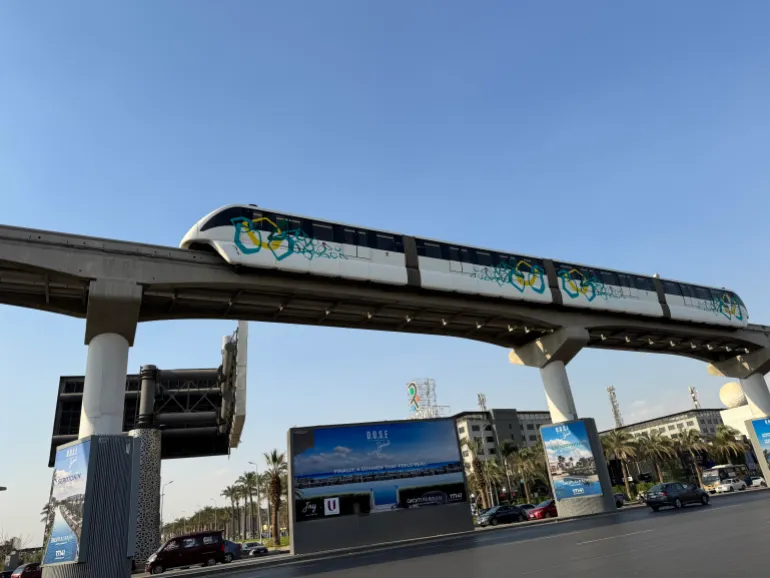
Cairo’s new monorail has been presented as a major step forward in modern transport, but public reaction shows a clear divide between admiration for the system and concern over its affordability and accessibility.
The East Nile monorail, which began partial operations in early May, runs 56.6 kilometres between Nasr City in Cairo and the New Administrative Capital. It is part of Egypt’s broader plan to reduce congestion in one of the world’s most crowded cities and improve links between the capital and newly developed urban areas.
Passengers describe the driverless electric train as clean, smooth, and comfortable. For many riders, the elevated journey offers a striking view of Cairo’s skyline as the train passes over busy roads, commercial districts, and residential areas.
One commuter, Mohammed Adel, said his trial journey from Musheer Tantawi station to the New Administrative Capital cost him 40 Egyptian pounds and offered a noticeably more comfortable experience than road transport. He said the ride saved him money compared with other travel options on the same route.
Another passenger, Hind Tarek, described the experience as similar to “flying” above the city. She said the monorail provides better access to newer districts and helps reduce pressure on Cairo’s heavily congested road network.
However, she also pointed to key drawbacks, including the distance required to reach stations and the cost of regular travel, which she considers too high for daily commuting.
This tension between modern infrastructure and practical affordability has become a central theme since the monorail opened to the public. While the system is technically advanced, many residents question whether it is designed for everyday use by ordinary commuters.
Cairo is one of the largest cities in the world, with more than 10 million residents. Its transport system has long struggled to meet demand, leading to chronic traffic congestion and pressure on public services.
The monorail is part of a wider transport strategy that includes metro expansion, light rail transit, and bus rapid transit systems. Officials say the goal is to build an integrated network that reduces reliance on private cars and improves mobility across the capital.
The project cost around 2.8 billion dollars and was developed with international and local partners, including Alstom, Arab Contractors, and Orascom. The system uses elevated tracks supported by concrete columns, reducing the need for major construction work at ground level.
At full capacity, the East Nile line is expected to carry up to 600,000 passengers per day. Authorities also estimate that the project could create around 20,000 jobs once fully operational.
The route connects major areas such as Nasr City, New Cairo, and the New Administrative Capital, passing over key landmarks and residential districts. The system is designed to integrate with other transport services, including metro lines and bus networks, to create smoother transfers across the city.
Despite its scale and ambition, early ridership levels appear modest. Some stations have reported relatively low passenger numbers during peak hours, raising questions about affordability and long-term usage patterns.
The monorail uses a tiered fare system, with prices ranging from 20 to 80 Egyptian pounds depending on travel distance. A discounted subscription plan offers a 50 percent reduction for regular commuters, but even with discounts, transport costs can still take up a significant share of monthly income.
With Egypt’s minimum wage set at around 8,000 pounds per month, regular use of the monorail can consume more than one-fifth of a worker’s earnings, not including additional transport needed to reach stations. This has raised concerns among transport experts about long-term accessibility for lower-income commuters.
Transport specialist Osama Aqeel said modern mass transit systems are essential for cities like Cairo, but stressed that affordability must be a key factor in design and policy.
He argued that while the monorail is part of a broader solution, other systems such as bus rapid transit may offer more cost-effective options for many residents.
Aqeel also noted that global standards suggest transport costs should not exceed a reasonable share of household income, a threshold that many commuters may struggle to meet if relying heavily on the monorail.
Other experts, however, believe it is too early to judge the system’s economic impact. Some argue that the project is still in its early operational phase and that pricing structures may evolve as ridership increases and the network expands.
They also highlight benefits beyond cost, including reduced travel time, improved comfort, and enhanced connectivity between key economic zones.
Despite differing opinions, there is broad agreement that Cairo urgently needs expanded public transport infrastructure. The city’s rapid population growth and increasing urban expansion continue to place pressure on existing systems.
The monorail represents a major investment in future mobility, but its success may depend on whether it can balance technological progress with the everyday needs of the people it is meant to serve.
For now, public opinion remains mixed. While some passengers praise the modern experience and efficiency, others question whether the system is truly accessible for all residents of Cairo.
