


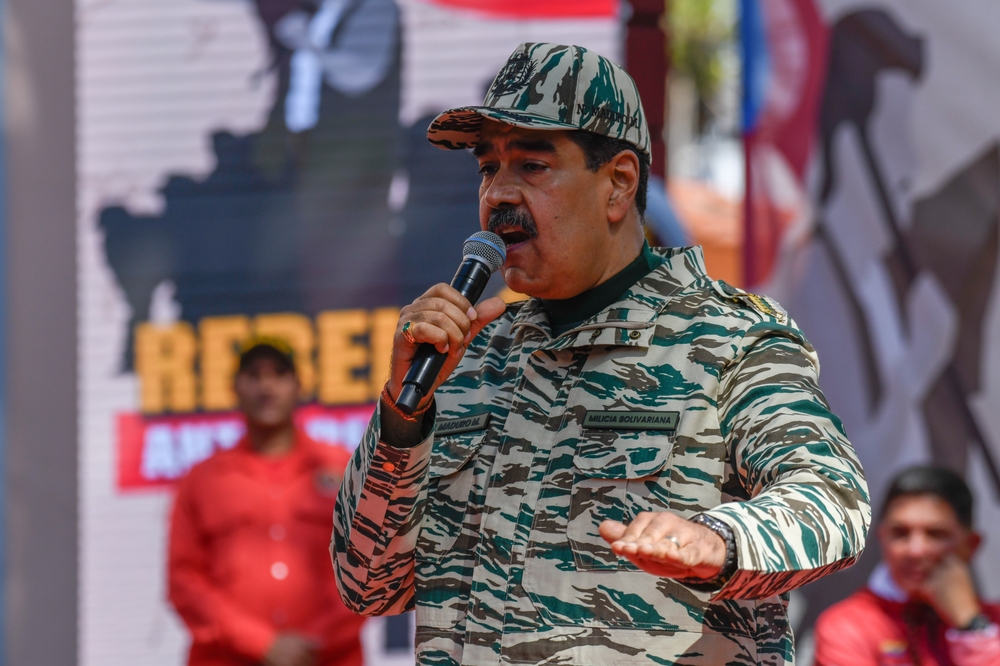
In a dramatic operation that caught the world off guard, US forces arrested Venezuelan President Nicolás Maduro and his wife, Cilia Flores, in Caracas and flew them to New York to face criminal charges. The move marks one of the most aggressive acts of US intervention in Latin America in decades.
Shortly after the arrests, US President Donald Trump announced that Washington would assume temporary control of Venezuela, saying the goal was to oversee a transition of power that would be “safe, proper and judicious.”
“We are going to run the country until such time as we can do a safe transition,” Trump said during a news conference at his Mar-a-Lago resort. “We can’t risk someone else taking over who doesn’t have the interests of the Venezuelan people in mind.”
Washington Claims Interim Control
Trump said the United States would manage Venezuela “with a group,” naming Secretary of State Marco Rubio, Defense Secretary Pete Hegseth, and Chairman of the Joint Chiefs of Staff General Dan Caine as key figures involved in overseeing the process. However, the president offered few specifics on how the interim administration would function or how long it would last.
At one point, Trump claimed Venezuela’s vice president, Delcy Rodríguez, had been sworn in as Maduro’s successor and was willing to cooperate with US plans. Venezuelan authorities, however, have not confirmed that any such swearing-in took place.
Trump also made clear that the US was prepared to deepen its involvement if necessary. He said American oil companies would move into Venezuela to rebuild the country’s damaged energy infrastructure and invest billions of dollars, adding that further military action remained an option.
“We’re not afraid of boots on the ground,” Trump said. “And we are ready to stage a second and much larger attack if we need to.”
Legal Justification and Congressional Backlash
Secretary of State Marco Rubio defended the operation as a law enforcement action backed by the US military, arguing that it did not require congressional approval. He pointed to Maduro’s 2020 indictment in the United States and said the Venezuelan leader was a fugitive with a $50 million reward on his head.
“He is not the legitimate president of Venezuela,” Rubio said. “He’s wanted by American justice. I guess we’re saving $50 million now.”
Trump added that Congress had not been informed in advance because of fears the plan could leak.
Democrats were quick to condemn the move. Senator Mark Warner, vice chairman of the Senate Select Committee on Intelligence, warned that the arrest set a dangerous precedent.
“If the United States claims the right to invade another country to arrest its leader, what stops China from making the same claim about Taiwan, or Russia from abducting Ukraine’s president?” Warner said. “Once this line is crossed, the rules that restrain global chaos begin to collapse.”
Warner also accused the administration of hypocrisy, pointing to Trump’s pardon of former Honduran President Juan Orlando Hernández, who had been convicted in a US court on drug trafficking charges.
Risks Ahead for Venezuela and the Region
Republicans largely backed Trump’s actions. Senator Roger Wicker, chair of the Senate Armed Services Committee, praised the operation and said it capped months of effort to dismantle what he called “narco-terrorist organizations” linked to Maduro’s government.
“The Venezuelan people must now act quickly to put their country back on a path to peace and prosperity,” Wicker said.
Analysts, however, warn that the fallout could be severe. Daniel DePetris of the think tank Defense Priorities said the arrest could trigger instability rather than reform.
“A split within the Venezuelan military, the growth of criminal groups, civil war, or the rise of an even worse autocrat are all possible outcomes,” he said. “None of those scenarios would be good for regional stability or US interests.”
DePetris also noted that the Trump administration’s justification for targeting Maduro has shifted repeatedly, ranging from drug trafficking and oil disputes to restoring democracy.
“In reality,” he said, “Venezuela is a bankrupt state whose economy has collapsed over the past decade. Portraying it as a major threat may give the Maduro regime more credit than it deserves.”
As Venezuela enters an uncertain new chapter, the long-term consequences of the US intervention remain deeply unclear—for the country itself, for the region, and for global norms around sovereignty and the use of force.
