


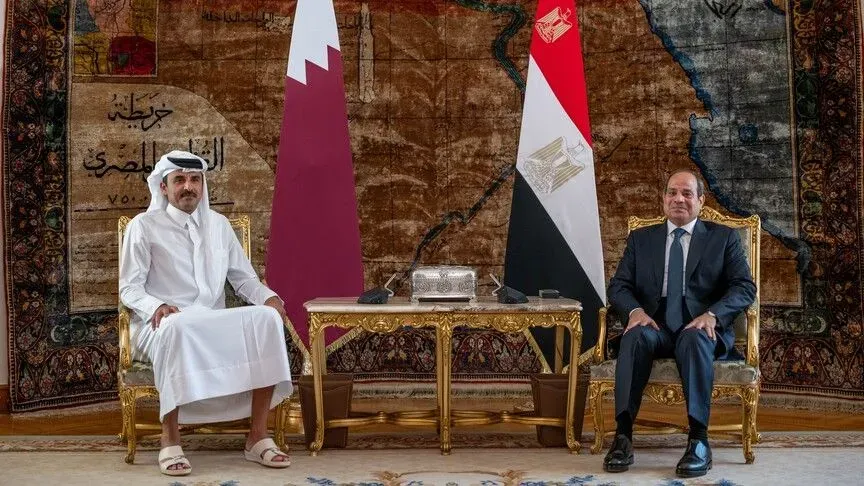
Qatar’s Emir Sheikh Tamim bin Hamad Al-Thani arrived in Cairo on November 26 for an official visit to Egypt, where he is expected to meet President Abdel-Fattah El-Sisi. The emir was received by the Egyptian president at Cairo International Airport at the beginning of the visit. The meeting marks another important step in relations between the two countries as they seek to strengthen political coordination, expand economic cooperation and discuss regional developments that have increased diplomatic pressure across the Middle East.
The visit follows discussions held in Cairo on Wednesday between Egyptian Foreign Minister Badr Abdelatty and Qatar’s Prime Minister and Foreign Minister Sheikh Mohammed bin Abdulrahman Al-Thani. The two ministers reviewed ways to develop bilateral relations and increase cooperation in areas where both countries see opportunities for growth. They also discussed trade, investment and the possibility of expanding economic partnerships. The talks provided a diplomatic foundation for the emir’s visit and highlighted the importance both governments place on direct communication.
Regional security is expected to be a major subject during the high-level discussions. Egypt and Qatar have been involved in diplomatic efforts aimed at reducing tensions connected to the crisis involving Iran. Their foreign ministers discussed mediation efforts with regional and international partners, stressing the need to prevent further escalation. Both sides have argued that dialogue and political solutions should remain central to efforts to protect regional stability. The visit gives their leaders an opportunity to review those efforts and consider how their countries can coordinate more closely.
The two governments have also exchanged views on developments in Libya and Sudan. Both countries have an interest in reducing instability across the region, although their diplomatic positions and priorities can differ. Egypt has particular security concerns because of its geographical proximity to Libya and Sudan, while Qatar has maintained an active role in regional diplomacy and humanitarian initiatives. Their discussions could therefore help identify areas where closer coordination is possible, especially on issues that require sustained engagement with other regional actors.
The visit also reflects the continuing effort by Cairo and Doha to build stronger relations after periods of political tension in previous years. Expanding investment and trade links could provide practical benefits for both economies, while regular high-level meetings may help the two governments manage disagreements and respond to regional crises. The results of the talks will be important in determining whether the latest diplomatic engagement leads to specific agreements or new joint initiatives. For now, the visit signals a willingness to maintain close contact at a time of uncertainty across the Middle East.
