


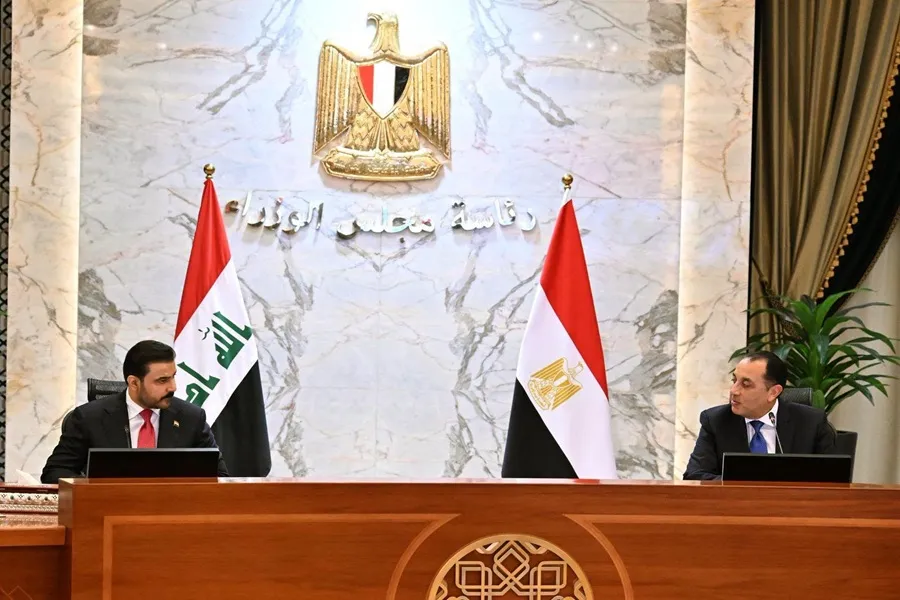
Egypt and Iraq have signed ten cooperation documents covering trade, taxation, health, media, science and other sectors. The agreements were completed in Egypt’s New Administrative Capital during Iraqi Prime Minister Ali Faleh Al-Zaidi’s first official visit to the country. Egyptian President Abdel-Fattah El-Sisi met Al-Zaidi before his departure, while Prime Minister Mostafa Madbouly and his Iraqi counterpart led the joint committee meeting that produced the agreements.
One of the key documents concerns the elimination of double taxation on income and capital. The agreement is designed to prevent tax evasion and reduce the risk of businesses being taxed twice when operating across the two countries. Officials also signed an agreement covering pharmaceutical and medical products, with the aim of strengthening cooperation between Egypt’s Drug Authority and Iraq’s health authorities.
The remaining documents cover a wide range of areas. They include cooperation between national broadcasting organisations, fisheries development, nuclear and radiation regulation, youth affairs and sports. Another agreement supports scientific research and exchanges between research institutions in Egypt and Iraq. The two governments also signed documents on planning and construction standards, showing that the partnership extends beyond traditional diplomatic and trade relations.
Economic cooperation was another major focus of the visit. Al-Zaidi met Egyptian business leaders and encouraged companies to invest in Iraq, particularly in agriculture, industry and construction. He said his government wanted to make investment procedures simpler and speed up decisions for foreign businesses. He also pointed to incentives available under Iraqi investment laws, including tax and customs exemptions for certain productive projects.
Madbouly said Egyptian companies were ready to contribute to Iraq’s development plans, drawing on their experience in infrastructure, energy, transport and industrial projects. The leaders also discussed regional security, the Gaza ceasefire and maritime navigation around the Arabian Gulf, Bab El-Mandeb and the Red Sea. Both sides expressed support for closer political consultation and stronger economic links. The ten documents mark another step in a partnership that previously produced twelve agreements during a joint committee meeting in Baghdad in January 2025.
